How do you check a supplier invoice against the agreed price?
You put the invoice next to the agreement that sets its prices and compare them line by line: the item, the price on the date it was supplied, the quantity and every fee. If you run procurement or operations, your job is to hold suppliers to what was agreed, and this comparison is how you do it. An agreement here means any document that sets a price you both accepted, whether a signed supply agreement, an order form, a statement of work, a price list or even your lease. Each invoice line should match a price in it, as it stood on the date of supply.
Which agreement sets the price?
The one in force when the goods or services were supplied, together with every amendment, a signed document that changes its terms from a stated start date. A supplier may also send a price notice, a letter or email announcing a new price, and your agreement decides whether a notice like that can change the price, and from which orders. Before you compare anything, gather the agreement, its amendments and any notices in one location, so you can determine which price applied on which date.
What is an escalation clause?
It is a term in the agreement that lets the price rise over time by a defined rule. Some clauses set a fixed rise on each anniversary of the start date. Others link the rise to an index, such as the Consumer Price Index, which the US Bureau of Labor Statistics publishes as a measure of the average change over time in the prices urban consumers pay. The clause usually says when the rise applies, how it is calculated, and whether there is a cap, the most the price can rise in one step. A supplier who applies a rise early, applies it twice, ignores the cap or rounds it up is billing more than the clause allows.
What do you compare, line by line?
You compare six things on every invoice, each against the document that sets it.
- Unit price: the price per item or per hour, against the agreement’s price for that item on that date, after any amendment or permitted rise.
- Quantity: the number billed, against what you ordered or what you received, whichever your team goes by.
- Fees and surcharges: every extra line, such as fuel, freight or handling, against a fee your agreement or a valid notice allows.
- Arithmetic: each line, the subtotal, any credit and the total, worked out again from the price and the quantity.
- Credits: money already paid and taken off, such as a deposit, against what the agreement says you paid in advance.
- Duplicates: the same invoice, or the same delivery under a different invoice number, billed a second time.
How do you spot price drift between invoices?
You line up the same item across several invoices from one supplier and check that every change in its price has a document behind it. Price drift is a price that creeps up between invoices with no amendment, notice or new agreement to justify it, so one invoice can look right on its own while the price has moved a few cents since spring. Comparing the item over time is what reveals the drift, because each individual increase looks too small to question.
Worked example: an amendment and an escalation clause at Ashcombe
Ashcombe Industrial Supply is an invented company, one of the Demo companies Ressura uses to show its checks, and every figure below is made up for the example. It is a wholesale distributor, and it buys boxed fasteners from a supplier under an agreement with two price terms.
The agreement sets $13.88 a case for twelve-packs of a hex bolt, and a signed amendment effective from 5 August lowers it to $13.65, in return for a larger annual commitment. The agreement also contains an escalation clause: on each anniversary, 1 March, the price may rise in line with the Consumer Price Index, capped at 4% in any year.
An invoice dated 19 August bills 1,200 cases at $14.14. Because the amendment applies from 5 August, the agreed price on the invoice date is $13.65, not $13.88, so the invoice is $0.49 a case over, and $0.49 multiplied by 1,200 is $588.00 on that single line.
Now suppose the supplier says $14.14 includes this year’s index rise. The clause allows a rise only on 1 March, and the amendment set a new price after that date, so no rise applies before next March. Even then, the most the clause allows on $13.65 is 4%, which is $0.546 a case; rounded to the cent, the highest price next March could reach is $14.20, and only if the index rose that much. Either way, the August invoice should read $13.65.
If Ashcombe orders that volume every month, the identical discrepancy repeats on every subsequent invoice until somebody formally raises it with the supplier.
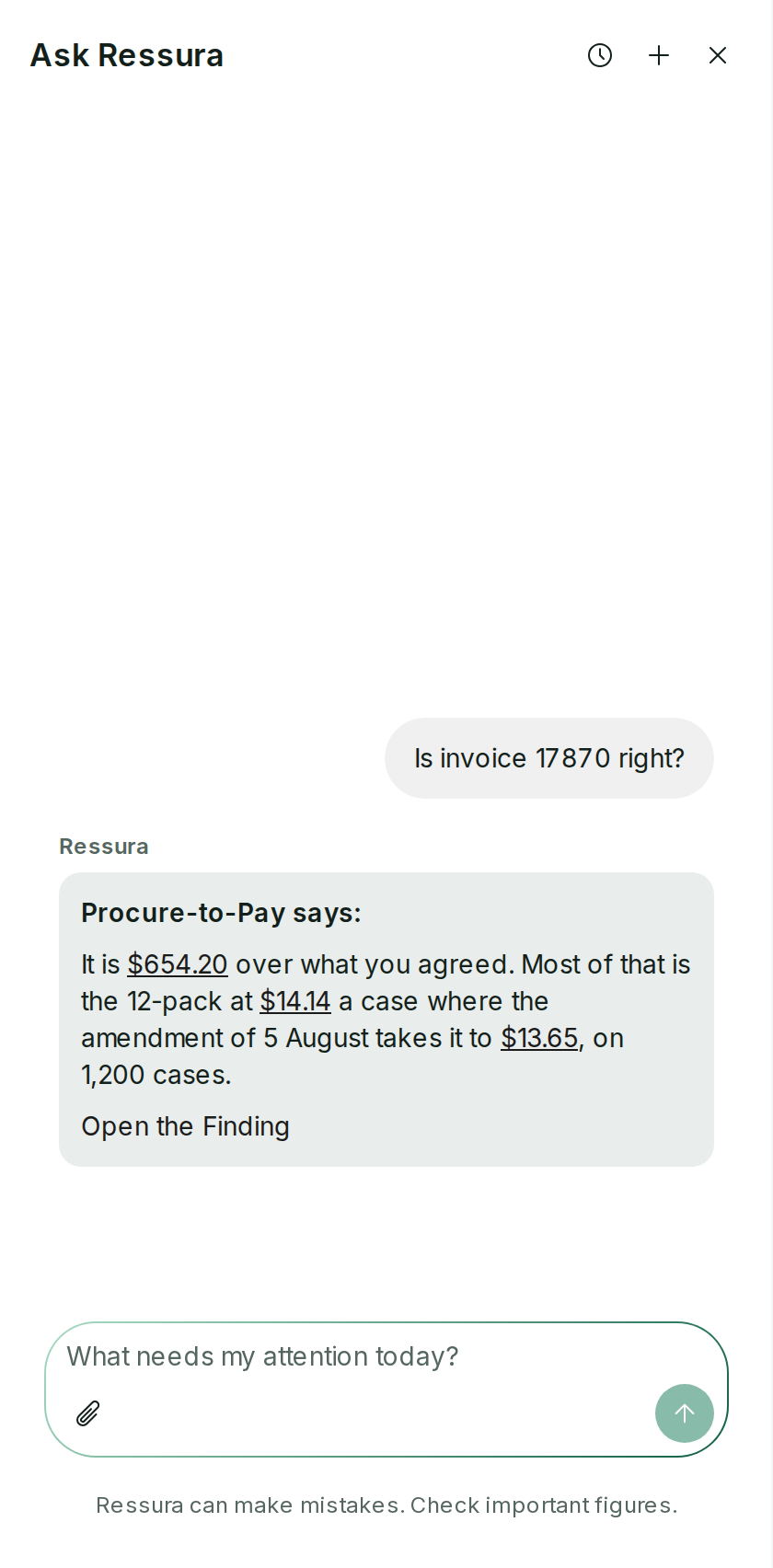
In the Picture above, the same comparison is asked of Ressura in plain words. The answer names the line and the amendment behind the price, and links the Finding with the arithmetic, so you can check it yourself before you raise it.
What do you do when you find a gap?
You raise it with the supplier in writing, presenting the agreement, the invoice and the gap side by side. Name the line, the price billed, the price agreed and the document that sets it, and ask for a credit note, a document from the supplier that reduces what you owe. Do it inside the dispute window, the number of days your agreement gives you to challenge an invoice, because a late dispute is easier for a supplier to refuse. Keep the reply with the invoice, so the next person to review it can see that the gap was raised and settled.
If a line is billed below the agreed price, record it too, as its own figure. It may be an error the supplier corrects later, and it is never subtracted from what the supplier owes you on the lines above the price.
How often should you check supplier invoices?
Check each invoice as it arrives and before it is paid, rather than once a year, because a gap found before payment costs one email to correct, while a gap found a year later means asking for money back, often after the dispute window has closed, and the same error has usually repeated on every invoice since. Checking every invoice, not a sample, is what lets you take the agreement, the invoice and the gap between them to the person you report to. For the signs that a supplier is overcharging in the first place, and how a clean result is reported, see how to tell if a supplier is overcharging you.
How can you check one invoice for free?
Ressura’s Procure-to-Pay Module makes this comparison for you. Add one agreement and one invoice billed against it, and it checks every unit price against the agreement on the invoice date, applies amendments from their start dates and price notices only to orders placed after them, matches each fee to one the agreement allows, and adds the invoice up again. Any gap is shown in dollars with the arithmetic beside it. When a supplier calls an item something different from your agreement, you confirm the match once and it is remembered. There is nothing to connect, and if every line matches, the result reads All in order and lists exactly what was checked.