Procure-to-Pay audits your suppliers against what you agreed to pay.
For the person who holds suppliers to what was agreed.
Your job is to catch a price that creeps up, a fee nobody agreed to, or an invoice sent twice. Every supplier invoice checked against what you agreed to pay, with the money you are overpaying shown in dollars.
3.3%
“A 3.3% overcharge found on TooSteppin Brewing’s supplier invoices in the first week, against the signed agreement.”
Are you being overcharged?
Audit a supplier for freeA Procure-to-Pay Finding, in its own words
Invoice 4471 charges $5.20 a foot for copper tube.
Your agreement with Cascade Pipe & Supply sets $4.85, and the amendment of 5 August takes it to $4.70. That is $0.50 a foot over on 1,200 feet: $600.00. The PVC pipe on the same invoice is at the amended price, so the amendment was applied to one item and not the others.
I cannot yet match the $1,450.00 credit on this invoice, the amount taken off what you owe. Your agreement expects a 25% deposit on a project order, and the deposit invoice is not in the Data Room. Add it and I will check again.
What Procure-to-Pay checks
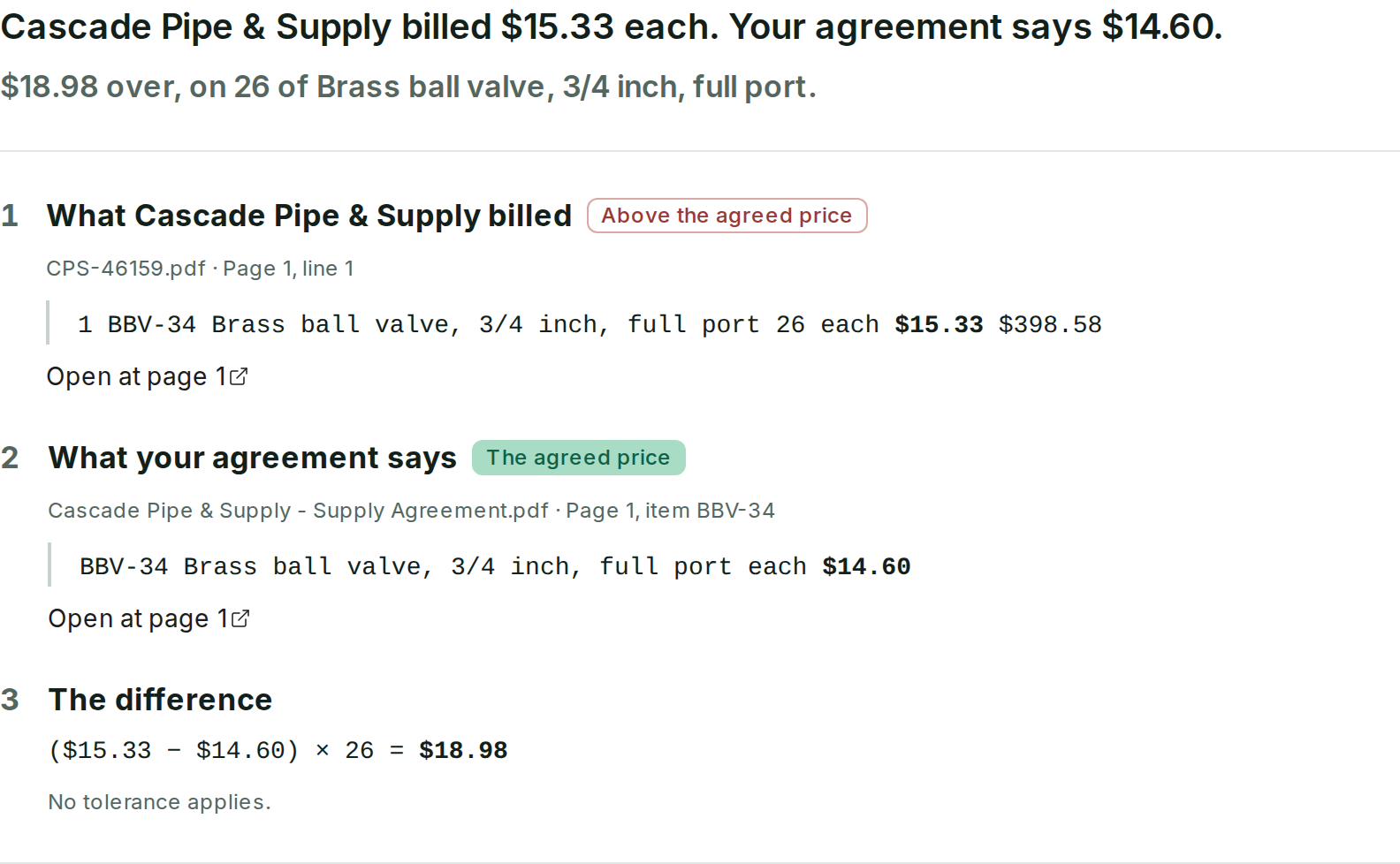
- Price against the agreementEvery unit price on an invoice is checked against the price your agreement sets for that item on that date.
- Amendment appliedA signed change to your agreement, an amendment, is applied from its start date on every line it covers.
- Notice reaches the orderA supplier’s notice of a new fee or price applies only to orders placed after it, where your agreement says so.
- Fee has a basisEvery extra line on an invoice, a fee or a surcharge, matches a fee your agreement or a valid notice allows.
- Quantity against the orderThe quantity on an invoice is checked against what you ordered or what you received, whichever you go by.
- ArithmeticEvery line, subtotal, credit and total on an invoice is added up again, so the arithmetic is right.
- Prepayment chainOn a final invoice, the credits (money already paid and taken off) match the deposit and earlier invoices your agreement calls for.
- DuplicateAn invoice that repeats another, by supplier, number and amount or by its content, is flagged as a duplicate.
- Price driftA supplier’s price for the same item does not move between invoices without an amendment, notice or new agreement that moves it.
- Dispute windowYou are shown how many days your agreement gives you to dispute an invoice, while that window is still open.
- Terminology mappingWhen a supplier calls an item something different from your agreement, the match is proposed once, confirmed by you, and remembered.
- Used up against billedFor each invoice under an agreement, what was billed to you is compared with what you have used up by period end.
- Missing accrualA fee your agreement commits you to for a period is raised as a cost to record when no invoice covers that period.
What Procure-to-Pay needs
- an agreement or price reference (an order form, a statement of work, a price list, even your lease)
- amendments and price notices, the documents that change a price after you signed
- orders and receiving records
- invoices
- credit notes, the supplier’s notes that reduce what you owe
- Connections, optional and only after your first Finding: QuickBooks Online, Xero or Google Drive. Nothing to connect to start.
Working with Procure-to-Pay, in Help, is the how-to: what to put in the Data Room, how to read a Finding and what each step costs.
What Procure-to-Pay may ask you
- When you check what a supplier delivered, do you go by the order or by what was received? Unless you say otherwise: received.
- If an agreement doesn’t say, how many days do you have to dispute a supplier’s invoice? Unless you say otherwise: 30.
- How much can a supplier’s price move before you want to hear about it? For example 2%. Unless you say otherwise: 2%.
- Any fees you pay that aren’t in the agreement? Name the supplier and the fee, like ‘Northwind Supply: fuel surcharge’.
- Does a supplier call an item something different from your agreement? Like ‘sixer’ for ‘6-pack case’.
- Do you post deferral journals (entries moving a cost billed early out of the month)? If so, to which accounts, like Prepaid expenses 1400? Unless you say otherwise: no.
- How big must a timing difference (a cost in the wrong month) be before you want to hear about it? For example 1,000. Unless you say otherwise: 1000.
Are you being overcharged?
Audit a supplier for freeProcure-to-Pay is included in Free, Starter, Professional and Enterprise, from $0 a month.
What Procure-to-Pay draws on
- Purchase prices match the agreementCOSO Control Activities, principle 10; SOX: Purchase-to-pay: pricing accuracy.FASB ASC 720-15 (expenses); COSO 2013
- Accuracy of recorded amountsCOSO Information and Communication, principle 13; SOX: Accuracy of transaction processing.PCAOB AS 1105.11 (audit evidence: relevance and reliability)
- Amendments and price notices are applied from the right dateCOSO Control Activities, principle 10; SOX: Contract change control.COSO 2013; PCAOB AS 1105 (reliability of evidence)
- Authorization of transactions and changesCOSO Control Activities, principle 10; SOX: Authorization of transactions.COSO 2013; PCAOB AS 2201.A5 (definition of internal control over financial reporting)
- Fees and surcharges have a basisCOSO Control Activities, principle 10; SOX: Authorization of non-standard charges.COSO 2013
- Invoiced quantity matches what was ordered or receivedCOSO Control Activities, principle 10; SOX: Three-way match.COSO 2013
- Deposits and progress invoices reconcile to the final invoiceCOSO Control Activities, principle 10; SOX: Prepayment and deposit accounting.FASB ASC 340-10 (prepaid expenses); ASC 606-10-45 (contract liabilities, receivable side)
- No transaction is recorded or paid twiceCOSO Control Activities, principle 10; SOX: Duplicate payment prevention.COSO 2013; PCAOB AS 1105 (sufficiency of evidence)
- Prices do not move without a documentCOSO Monitoring Activities, principle 16; SOX: Vendor pricing monitoring.COSO 2013
- Dispute deadlines are surfaced while openCOSO Information and Communication, principle 14; SOX: Contract compliance monitoring.COSO 2013 principle 14 (internal communication)
- A cost is used up over the period it pays for, and the rest is paid aheadCOSO Control Activities, principle 10; SOX: Prepaid expenses and expense attribution.FASB ASC 340-10 (other assets and deferred costs: prepaid expenses); IFRS prepayment guidance (IAS 1 paragraph 66 on current assets, IAS 38 paragraph 70 on prepayments for services)
- A contracted period fee is invoiced, and a contracted cost is accrued, in the period it belongs toCOSO Information and Communication, principle 13; SOX: Completeness of revenue and of accrued liabilities at period end.FASB ASC 606-10-45-1 to -4 (contract assets and receivables) and FASB ASC 405-20 (liabilities); IFRS 15 paragraphs 105 to 108 (contract assets) and IAS 37 paragraph 11 (accruals); PCAOB AS 2401.66 (cut-off)
- Payables are complete and realCOSO Control Activities, principle 10; SOX: Accounts payable completeness and existence.FASB ASC 405-20 (extinguishment of liabilities); PCAOB AS 2810