Tax & Compliance audits sales tax, tax on purchases and your filings.
For the person who closes the month with the tax checked.
Your job is to claim back only the tax the regulations allow, and to have the forms on file for the contractors you pay. The tax on every invoice you send and receive checked for where you operate, every filing reconciled to your books, and the next due date always in view.
Are you charging and paying the right tax?
Start freeA Tax & Compliance Finding, in its own words
Invoice 2088 to a Tacoma homeowner charges 6.5% sales tax.
Your rules for Washington set the Tacoma combined rate at 10.3% on Ferrygate’s residential work. That is $38.00 under-collected on $1,000.00.
Your June Washington combined excise tax return reports $4,210.00 of sales tax collected. The ledger’s sales-tax payable for June, the tax collected and not yet paid over, shows $4,655.00. The difference is $445.00; tell me where it went, or I will keep the difference open.
What Tax & Compliance checks
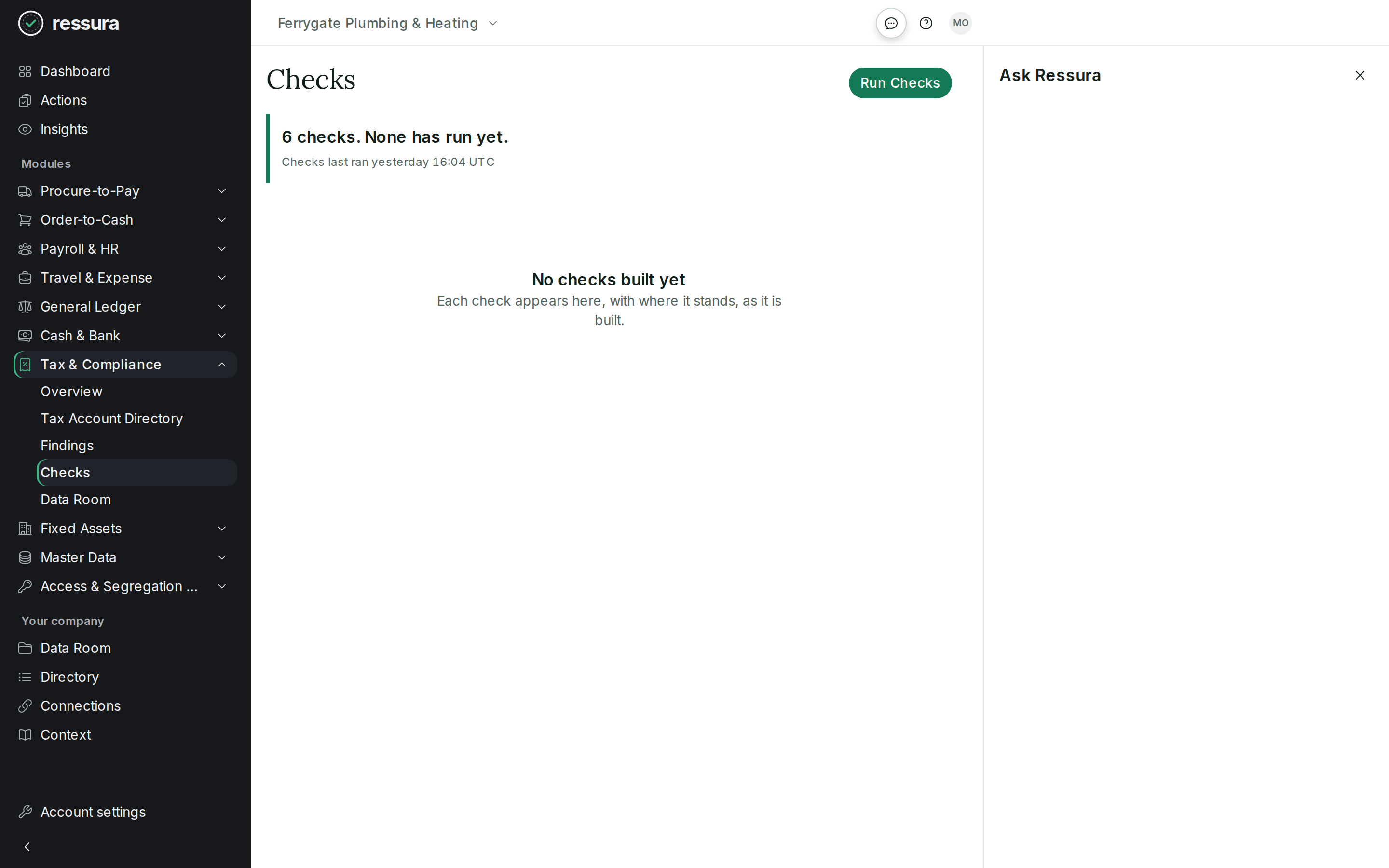
- Sales tax rate on invoicesThe tax rate on each sales invoice line equals the rate for the customer’s location and the item, in the places you operate.
- Tax on purchases recoverableTax you claim back on a supplier invoice is allowed under the rules you have given, and the invoice supports it.
- Withholding on contractor paymentsA contractor paid more than the reporting threshold in a year has a tax id and the reporting form on file.
- Filing reconciles to the ledgerThe amounts on each filing equal the tax accounts in your books for the period.
- Filing on timeEvery filing on your calendar is filed by its due date, and the next due date is shown while it is open.
- Tax accounts clearThe tax you owe and the tax owed to you go to zero each period, once filed and paid.
What Tax & Compliance needs
- the states you operate in and the filings you make, the two questions asked first
- your sales invoices and supplier invoices, with their tax lines
- your filings, and the tax report from your accounting system
- your tax accounts in the books, for each filing to match against
- Connections, optional: QuickBooks or Xero, which bring the invoices you send and receive and the tax accounts. A tax report and a filing are sufficient to start.
Working with Tax & Compliance, in Help, is the how-to: what to put in the Data Room, how to read a Finding and what each step costs.
What Tax & Compliance may ask you
- Which tax filings do you make, and how often? For example ‘Colorado sales tax, monthly’.
- For each state, what is your sales tax registration number?
- Do you sell anything that isn’t taxed, like wholesale beer to distributors?
- Above what amount in a year do you report a contractor’s payments? Leave blank for the IRS figure. Unless you say otherwise: 600.
- Any purchase tax you can claim back, and any you can’t?
Are you charging and paying the right tax?
Start freeTax & Compliance is included in Free, Starter, Professional and Enterprise, from $0 a month.
What Tax & Compliance draws on
- Sales tax on invoices is right for the place and the itemCOSO Control Activities, principle 10; SOX: Indirect tax accuracy.FASB ASC 606-10-32-2A (taxes collected from customers); state revenue department rate tables (public)
- Tax on purchases is claimed only where it can beCOSO Control Activities, principle 10; SOX: Indirect tax recovery.State revenue department rules on exemptions and resale (public)
- Contractor payments are reportedCOSO Control Activities, principle 10; SOX: Information reporting compliance.26 U.S.C. 6041 (information at source, public domain); IRS Form 1099-NEC instructions (public domain)
- Filings match the books and are made on timeCOSO Information and Communication, principle 13; SOX: Tax compliance calendar and reconciliation.State revenue department filing calendars (public); IRS due dates (public)
- Period-end close is complete and timelyCOSO Information and Communication, principle 13; SOX: Period-end financial reporting process.COSO 2013; PCAOB AS 2201.26 (period-end financial reporting)