General Ledger audits every journal entry and who approved it.
For the person who closes the month with every journal checked.
Your job is to close the month with every balance tied to the records behind it, and nothing left unexplained. Every journal entry, each posting in your books, checked for who made it, when, for how much and with whose approval, before your board sees the numbers.
Are journal entries approved and posted correctly?
Start freeA General Ledger Finding, in its own words
Journal 1187 for $18,000.00 was prepared and approved by the same user on 30 June, the last day of the quarter.
Your rule says hand-posted entries above $10,000 need a second reviewer.
Suspense account 9999, where unknown items are parked, has held $2,340.00 since 3 May: a payment to Salish HVAC Parts & Controls with no invoice behind it. Tell me where it belongs, or post it, and I will clear the Finding.
What General Ledger checks
- Manual entry above threshold reviewedA hand-posted journal entry above the amount you set has a reviewer who is not the person who prepared it.
- Preparer is not approverNo journal entry is prepared and approved by the same person.
- Period-end and backdated entriesAn entry posted after a period closed but dated inside it, or posted in the period’s last two days, is flagged.
- Accrual reversedEvery accrual, a cost booked before its invoice arrives, reverses in the next period unless you have said it stands.
- Suspense and uncategorized clearedNo balance sits in a suspense or uncategorized account, the parking place for unknown items, for more than 30 days at period end.
- Sub-ledger tiesThe payables, receivables, cash and asset balances in your ledger equal the totals of the detailed records behind them.
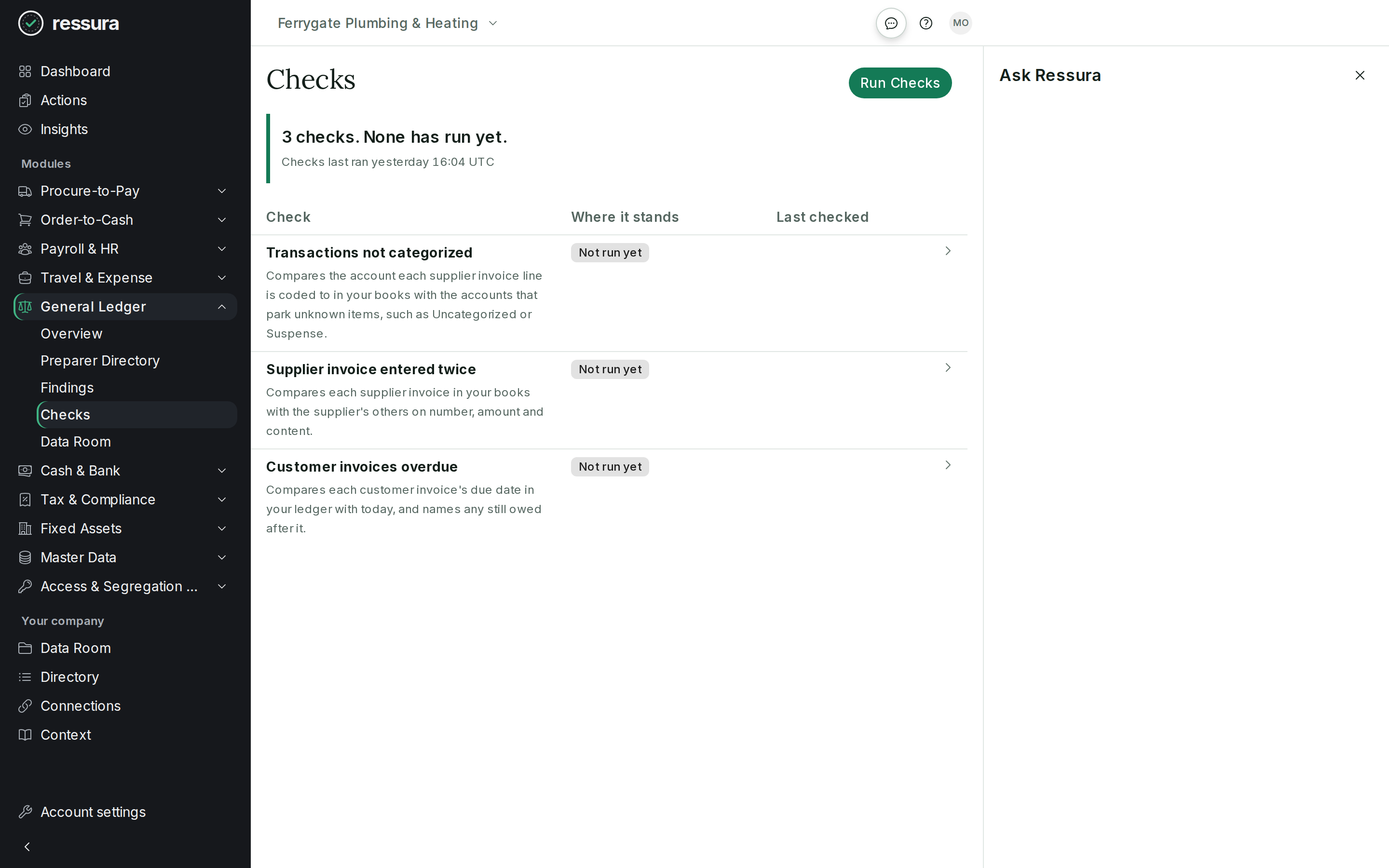
- Transactions not categorizedEvery supplier invoice line in your books is coded to an account, and none sits in Uncategorized, Suspense or Ask My Accountant.
- Supplier invoice entered twiceNo supplier invoice is in your books twice, under the same number and amount or with the same content.
- Customer invoices overdueA customer invoice still owed after its due date is shown with the days overdue and the amount still owed.
What General Ledger needs
- your journal entries, every line, as a ledger export or through a Connection
- your chart of accounts, the list of accounts your books use
- your approval rules and the amount above which an entry needs a second reviewer, asked for only when a check needs them
- Connections, optional: QuickBooks or Xero, which bring every journal entry and the chart of accounts. A ledger export is enough to start.
Working with General Ledger, in Help, is the how-to: what to put in the Data Room, how to read a Finding and what each step costs.
What General Ledger may ask you
- Above what amount should a hand-posted journal entry get a second pair of eyes? Unless you say otherwise: 5000.
- How many days after month end do you close the books? Unless you say otherwise: 10.
- Which accounts do you park unknown items in? For example ‘Suspense’ or ‘Uncategorized’. Unless you say otherwise: accounts named suspense or uncategorized.
- Any accruals that stay on the books rather than reversing next month? Name them.
- Any unusual account pairings that are normal for you? For example ‘Marketing expense against Accrued liabilities’.
Are journal entries approved and posted correctly?
Start freeGeneral Ledger is included in Free, Starter, Professional and Enterprise, from $0 a month.
What General Ledger draws on
- Manual journal entries are reviewed by a second personCOSO Control Activities, principle 10; SOX: Journal entry controls.PCAOB AS 2401.58-.67 (journal entries and other adjustments)
- Review above a threshold, and patterns just below itCOSO Monitoring Activities, principle 16; SOX: Management review controls.COSO 2013; PCAOB AS 2401.66 (characteristics of fraudulent entries)
- Segregation of dutiesCOSO Control Activities, principle 10; SOX: Control activities over initiation, authorization, recording and reporting.COSO 2013; PCAOB AS 2201.42 (note, smaller companies); AICPA AU-C 315.A179; AICPA AU-C 265.A5
- Entries are posted in the period they belong to, not after it closedCOSO Information and Communication, principle 13; SOX: Period-end journal cut-off.PCAOB AS 2401.66; COSO 2013
- Cut-offCOSO Information and Communication, principle 13; SOX: Period-end financial reporting.FASB ASC 606-10-25 (timing of revenue); PCAOB AS 2401.66
- Entries with the shape of a problem are surfacedCOSO Monitoring Activities, principle 16; SOX: Journal entry analytics.PCAOB AS 2401.66 (characteristics of fraudulent journal entries)
- Accruals reverse and suspense accounts clearCOSO Information and Communication, principle 13; SOX: Period-end close controls.COSO 2013; PCAOB AS 2201.26
- Period-end close is complete and timelyCOSO Information and Communication, principle 13; SOX: Period-end financial reporting process.COSO 2013; PCAOB AS 2201.26 (period-end financial reporting)
- The ledger agrees with its sub-ledgersCOSO Information and Communication, principle 13; SOX: Sub-ledger to general ledger reconciliation.COSO 2013; PCAOB AS 2810
- No transaction is recorded or paid twiceCOSO Control Activities, principle 10; SOX: Duplicate payment prevention.COSO 2013; PCAOB AS 1105 (sufficiency of evidence)
- Receivables are complete, real and collected on termsCOSO Monitoring Activities, principle 16; SOX: Accounts receivable completeness and aging.FASB ASC 310-10 (receivables); ASC 326-20 (credit losses, context only)