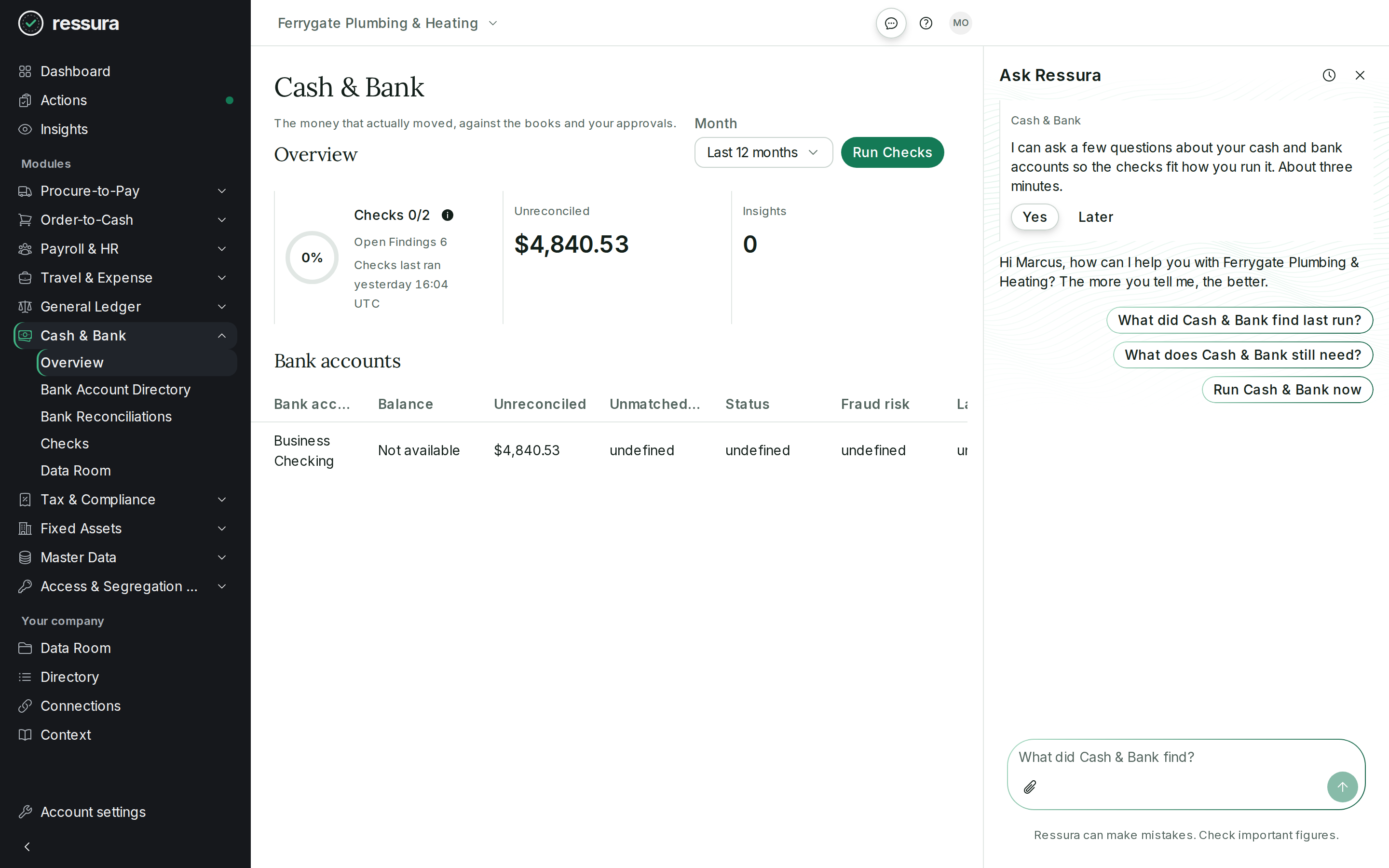
Cash & Bank audits every payment against your books and approvals.
For the person who shows every payment matches the books.
Your job is to spot an invoice paid twice, or a card charge with no receipt behind it. Every bank and card transaction matched to your books and your approvals, so the bank and the books agree every month.
A Cash & Bank Finding, in its own words
Payment of $18,450.00 to Salish HVAC Parts & Controls on 12 August went to an account that is not the one on the supplier’s record, which has been unchanged since March.
The account changed on the invoice dated 9 August, three days before the payment.
A $240.00 charge at Pacific Tool & Equipment on the company card on 6 August has no receipt or invoice in the Data Room, and your receipt threshold is $50.00. Add the receipt, or tell me why it has none.
What Cash & Bank checks
- Bank and card lines not reconciledEvery bank and card line of a closed month matches a line in your books, or is raised in the class that explains it.
- Balances tieThe bank balance at month end equals the cash balance in your books, plus the items still to be matched.
- Payment to an approved accountEvery payment goes to the account on the supplier’s record, and a payment to a new or changed account is flagged.
- Authorization limitA payment above the limit you set has a recorded approver.
- Duplicate paymentThe same payee paid the same amount twice within 30 days, across bank, card and books, is flagged as a duplicate.
- Card charge without supportA card charge above your receipt threshold with no receipt or invoice in the Data Room is flagged.
- Spend within policyA card charge is checked against your card policy, its categories, limits and merchants, when you have given one.
What Cash & Bank needs
- bank statements, or the bank transactions themselves through a Connection
- card transactions
- receipts and invoices for card charges, so a charge has support
- your approval limits and card policy, asked for only when a check needs them
- Connections, optional: your bank through Plaid for your accounts and their balances, and QuickBooks or Xero for the books they are matched to. A statement is enough to start.
Working with Cash & Bank, in Help, is the how-to: what to put in the Data Room, how to read a Finding and what each step costs.
What Cash & Bank may ask you
- How many days can a bank item sit unmatched before you want to hear about it? Unless you say otherwise: 30.
- How many days can a payment in your books wait to clear the bank before you call it stale? Unless you say otherwise: 90.
- How many times bigger than a normal payment counts as unusual for an account? For example 3 times. Unless you say otherwise: 3.
- Any accounts where big regular payments are normal? For example a payroll sweep account.
- Who owns each recurring charge on your cards? For example ‘Notion: Sam’.
- Any rules for card spend? Category limits or blocked merchants, like ‘no alcohol’ or ‘travel under $500’.
Does every payment match your books and approvals?
Start freeCash & Bank is included in Free, Starter, Professional and Enterprise, from $0 a month.
What Cash & Bank draws on
- The bank and the books agreeCOSO Control Activities, principle 10; SOX: Cash reconciliation.COSO 2013; PCAOB AS 2810.10-.13
- Money goes only to approved accountsCOSO Control Activities, principle 10; SOX: Disbursement authorization and payee validation.COSO 2013; PCAOB AS 2401.66 (fraud risk in disbursements)
- Changes to master data are controlledCOSO Control Activities, principle 11; SOX: Master file maintenance controls.COSO 2013 principle 11 (general controls over technology)
- Authorization of transactions and changesCOSO Control Activities, principle 10; SOX: Authorization of transactions.COSO 2013; PCAOB AS 2201.A5 (definition of internal control over financial reporting)
- Unusual payments are noticedCOSO Monitoring Activities, principle 16; SOX: Disbursement monitoring.COSO 2013; PCAOB AS 2401.66
- No transaction is recorded or paid twiceCOSO Control Activities, principle 10; SOX: Duplicate payment prevention.COSO 2013; PCAOB AS 1105 (sufficiency of evidence)
- Recurring charges have an owner and a useCOSO Monitoring Activities, principle 16; SOX: Expense validity.FASB ASC 720-15 (start-up and ongoing expenses); COSO 2013
- Card spend is supported and within policyCOSO Control Activities, principle 10; SOX: Corporate card controls.COSO 2013; 26 CFR 1.62-2 (accountable plan substantiation, public domain)
- Transactions are supported by documentsCOSO Information and Communication, principle 13; SOX: Audit trail and supporting evidence.PCAOB AS 1105.06-.10 (audit evidence)