Master Data audits your supplier, customer and employee records.
For the person who keeps supplier and customer records in order.
Your job is to know when a supplier’s bank details change, and who changed them. Your supplier, customer and employee records checked so each is complete, none is the same thing twice, and no supplier is also one of your people.
Has anyone changed a supplier’s bank details?
Start freeA Master Data Finding, in its own words
Supplier ‘Cascade Pipe & Supply’ and supplier ‘Cascade Pipe and Supply’ share the same tax id and are paid to the same account.
They are one supplier under two records. Tell me which to keep and I will propose the merge.
Supplier ‘Ferrygate Properties LLC’, which leases you the shop, shares its owners with Ferrygate Plumbing & Heating. That may be known; if so, add it to context as a related party and I will record it.
What Master Data checks
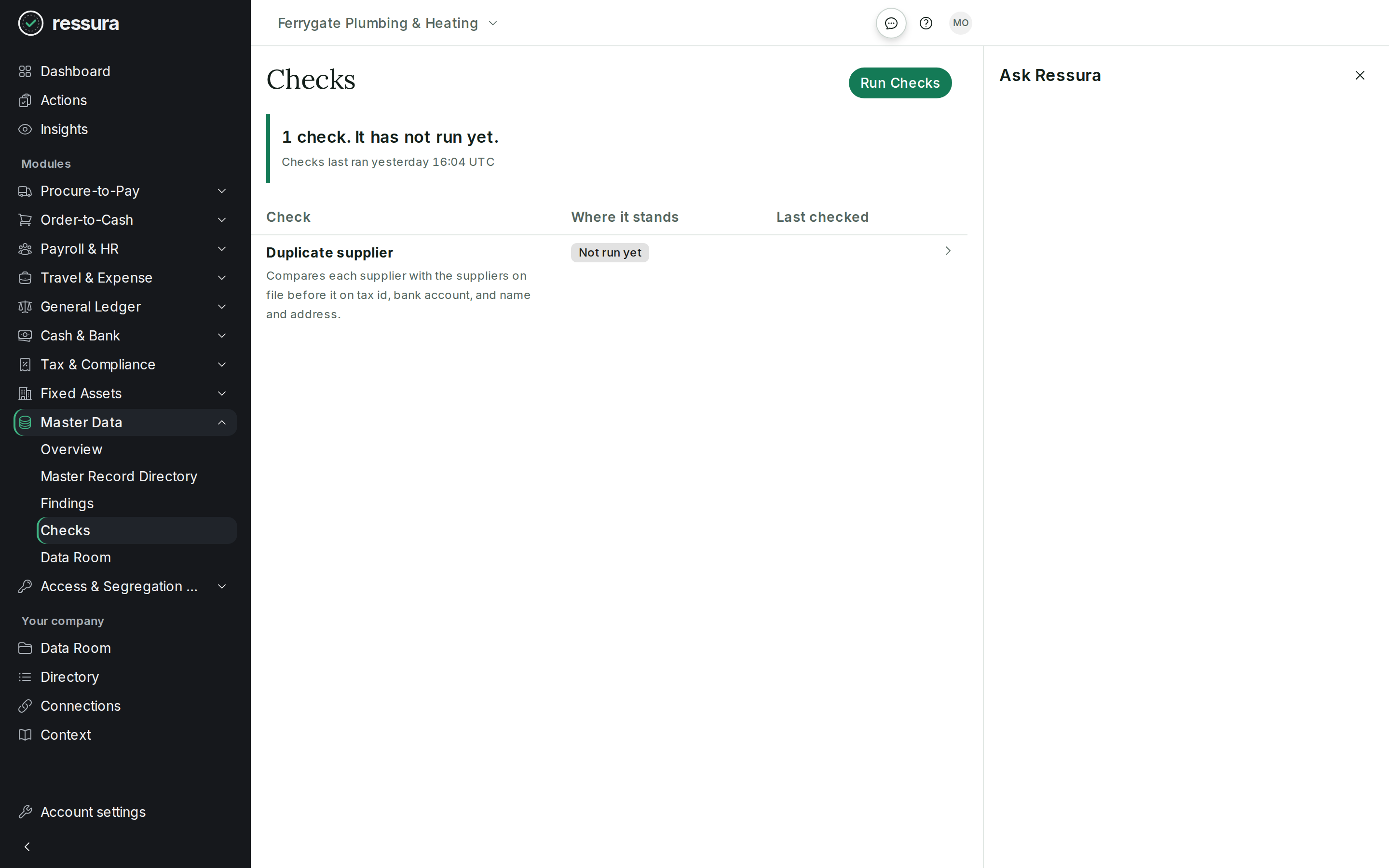
- Duplicate supplierNo two supplier records share a tax id, a bank account, or a name and address that closely match.
- Duplicate customerNo two customer records share a tax id, or a name and address that closely match.
- Supplier is not an employeeNo supplier shares a bank account, address, phone or tax id with an employee.
- Record completeEvery active supplier has a tax id, address and bank account on file, and every customer an address and billing contact.
- Dormant then reactivatedA supplier with no activity for twelve months that is paid again is flagged before the payment clears.
- Bank details changedEvery change to a supplier’s bank details is logged with who changed it and when, and flagged.
- Cross-reference agreesThe same supplier or customer carries the same id in every connected system, or a match you have confirmed.
What Master Data needs
- your supplier and customer lists, from your accounting system or as a spreadsheet
- your employee list, with addresses and payment details, so a supplier can be checked against it
- Connections, optional: QuickBooks or Xero for suppliers and customers. Two lists are enough to start.
Working with Master Data, in Help, is the how-to: what to put in the Data Room, how to read a Finding and what each step costs.
What Master Data may ask you
- What must every supplier record have? For example tax id, address, bank account. Unless you say otherwise: tax id, address and bank account for suppliers; address and billing contact for customers.
- After how many days without activity is a supplier ‘dormant’? Unless you say otherwise: 365.
- Is anyone on your team also a supplier on purpose? Name them.
- Does the same supplier have different ids in Xero and your bank? Give both.
Has anyone changed a supplier’s bank details?
Start freeMaster Data is included in Free, Starter, Professional and Enterprise, from $0 a month.
What Master Data draws on
- Each supplier and customer exists onceCOSO Control Activities, principle 11; SOX: Master data integrity.COSO 2013 principle 11; PCAOB AS 2401.66
- Suppliers are not employees in disguise, and dormant suppliers do not wake up quietlyCOSO Control Environment, principle 1; SOX: Vendor master fraud risk.PCAOB AS 2401.66; FASB ASC 850-10 (related parties)
- Related parties are identifiedCOSO Control Environment, principle 1; SOX: Related-party transaction identification.FASB ASC 850-10 (related party disclosures)
- Master records have what a payment needsCOSO Control Activities, principle 11; SOX: Master data completeness.COSO 2013; IRS Form W-9 (tax id collection, public domain)
- Changes to master data are controlledCOSO Control Activities, principle 11; SOX: Master file maintenance controls.COSO 2013 principle 11 (general controls over technology)