Access & Segregation of Duties audits who can approve what in finance.
For the person who closes the books knowing who can approve what.
Your job is to show that people who left lost their access, and that every admin account was reviewed. Who can do what in your finance systems, checked against your rules every quarter, with every time one person did two jobs that should take two.
Can anyone approve their own payments?
Start freeAn Access & Segregation of Duties Finding, in its own words
User U-004 created supplier ‘Pacific Tool & Equipment’ on 2 May, entered supplier invoice 5490 for $4,850.00 against it on 3 May, and approved the payment on 4 May.
Your rules say creating a supplier and approving its payment take two people. No exception is recorded.
User U-011 has admin access to QuickBooks Online and no activity since 14 February. Confirm the account is still needed or remove it.
User U-017’s Microsoft Entra ID login was disabled on 20 August, and their QuickBooks Online login is still Active. No leaving date is known for them, so the disabling is read as the day they left.
What Access & Segregation of Duties checks
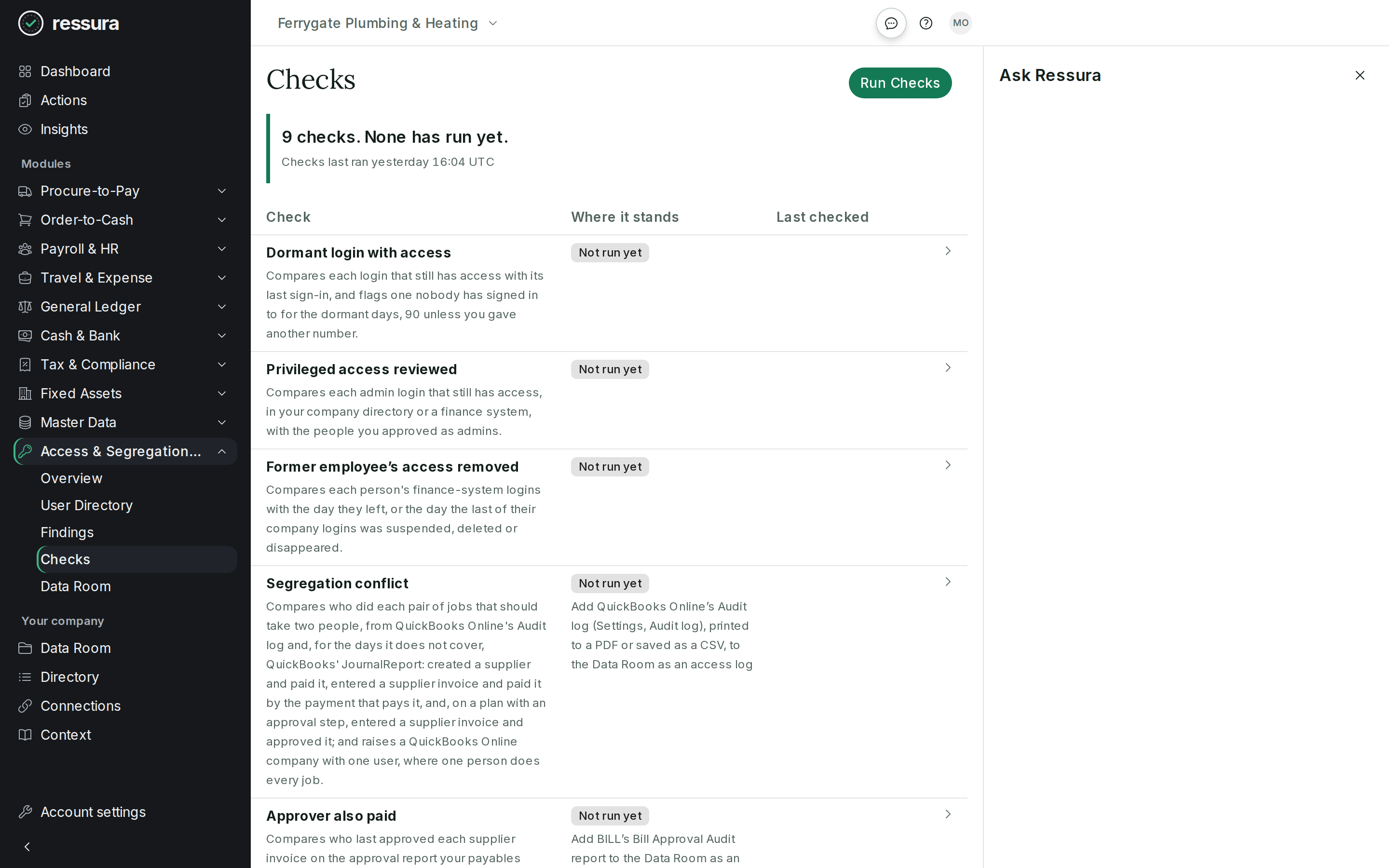
- Segregation conflictNo one both created and approved the same supplier invoice, payment, journal entry or supplier record.
- Approver also paidNo one both approved and paid the same supplier invoice on your approval report, such as BILL’s Bill Approval Audit report.
- One approver for everythingNot every supplier invoice on your approval report was approved by the same one person.
- Conflicting rolesNo one holds two roles your rules say one person should not hold, unless you have approved an exception.
- Approval limit respectedNo approval was given above the approver’s limit, and no limit was raised without a second person.
- Privileged access reviewedEvery admin account is on your approved list and was reviewed in the last quarter.
- Change to a financial setting approvedA change to a tax rate, approval rule, bank account or list of accounts in a connected system has a recorded approver.
- Dormant login with accessA login nobody has signed in to for 90 days that still has access is flagged.
- Former employee’s access removedA person who left, or whose company logins all ended, and still has a finance-system login open after that day is flagged.
What Access & Segregation of Duties needs
- the user lists and roles from your finance systems
- their audit logs, the record of who did what and when
- your employee list with leaving dates, or a leaving date typed on the person in the User Directory, so a former employee’s access is measured from the day they left
- your segregation rules and approved exceptions, or the six pairs of jobs we start from if you have none
- Connections, optional: Google Workspace or Microsoft Entra ID, which bring who is in the company and who is an admin; QuickBooks or Xero, which bring the user list and the log of who did what. A user list and a log export are enough to start.
Working with Access & Segregation of Duties, in Help, is the how-to: what to put in the Data Room, how to read a Finding and what each step costs.
What Access & Segregation of Duties may ask you
- Which two jobs should never be done by the same person? Leave blank for the standard six pairs. Unless you say otherwise: create supplier and approve payment, enter supplier invoice and approve supplier invoice, prepare journal and approve journal, change bank details and pay, create user and assign role, run payroll and approve payroll.
- Anyone allowed to do both jobs on purpose? For example the owner in a two-person company. Unless you say otherwise: the Owner.
- Who is allowed to be an admin in your company directory and your finance systems?
- After how many days without a sign-in should a login be flagged? Unless you say otherwise: 90.
- How often do you review who has access? Unless you say otherwise: quarterly.
Can anyone approve their own payments?
Start freeAccess & Segregation of Duties is included in Free, Starter, Professional and Enterprise, from $0 a month.
What Access & Segregation of Duties draws on
- Conflicting duties are not held or exercised by one personCOSO Control Activities, principle 10; SOX: Segregation of duties in financial systems.PCAOB AS 2201.42 (note, smaller companies); AICPA AU-C 315.A179, .A279 (appendix F, access); COSO 2013 principle 10
- Segregation of dutiesCOSO Control Activities, principle 10; SOX: Control activities over initiation, authorization, recording and reporting.COSO 2013; PCAOB AS 2201.42 (note, smaller companies); AICPA AU-C 315.A179; AICPA AU-C 265.A5
- Changes to financial settings and limits are approvedCOSO Control Activities, principle 11; SOX: Change management over financial systems.PCAOB AS 2201.47, .B29 (IT general controls); AICPA AU-C 315.A279 (appendix F, changes); COSO 2013 principle 11
- Authorization of transactions and changesCOSO Control Activities, principle 10; SOX: Authorization of transactions.COSO 2013; PCAOB AS 2201.A5 (definition of internal control over financial reporting)
- Access is granted on purpose, reviewed on schedule, and removed when people leaveCOSO Control Activities, principle 11; SOX: Logical access controls (IT general controls).PCAOB AS 2201.47, .B29 (IT general controls); AICPA AU-C 315.A279 (appendix F, access); COSO 2013 principle 11