Order-to-Cash audits every customer invoice against your agreement.
For the person who closes the month on what customers were billed.
Your job is to close the month with every fee billed, every credit explained, and each sale in the month it was earned. Every invoice you send checked against what the customer agreed to pay, with the money you are not collecting shown in dollars.
Are you invoicing customers correctly?
Audit a supplier for freeAn Order-to-Cash Finding, in its own words
Invoice 2041 charges $92.00 an hour for service labor.
The quote Ferrygate sent Westgate Senior Living on 12 June sets $98.00 an hour from 1 July. That is $6.00 an hour under on 38 hours: $228.00 not invoiced. Did you agree the lower rate with Westgate? If so, tell me and I will re-test.
Credit note CN-118 takes $640.00 off what Commencement Bay Apartments owes. I cannot find a return, a warranty callback, a dispute or a term of the quote it ties to. If there is one, add it to the Data Room. If not, tell me the reason and I will re-test.
What Order-to-Cash checks
- Price against the agreementEach price you invoice is checked against the price the customer agreed for that item on that date.
- Amendment appliedAn amendment, a signed change to the agreement, applies from its start date on every line it covers.
- Notice reaches the orderA price notice you sent applies only to orders placed after it, where the agreement says so.
- Fee has a basisEvery extra fee you charge is one the agreement allows, and every fee it allows is charged.
- Quantity against the orderThe quantity you invoice is checked against what the customer ordered or what you delivered.
- ArithmeticEvery line, subtotal, credit and total on your invoice is added up again, so the sums are right.
- Prepayment chainA final invoice takes off the deposit and earlier invoices the agreement calls for, with credits that match them.
- DuplicateAn invoice that repeats another by customer, number and amount, or by what it says, is flagged.
- Price driftYour price for the same item to the same customer only moves between invoices when a document moves it.
- Dispute windowWhile a customer can still dispute your invoice, you see how many days the agreement gives them.
- Terminology mappingWhen your invoice names an item in words the agreement does not use, you confirm the match once and it is remembered.
- Credit note has a basisEvery credit note, which cuts what a customer owes, ties to a return, a dispute or a term of the agreement, for that amount.
- Discount authorizedAny price below the agreed one has a clause in the agreement or an approval you recorded.
- Payment against termsAn invoice past its payment terms is shown with the days overdue and the amount still owed.
- Earned against billedWhat you billed on each invoice under an agreement is set against what was earned by the end of the period.
- Revenue cut-offAn invoice’s date is checked against the delivery note or service dates, so revenue sits in the month it was earned.
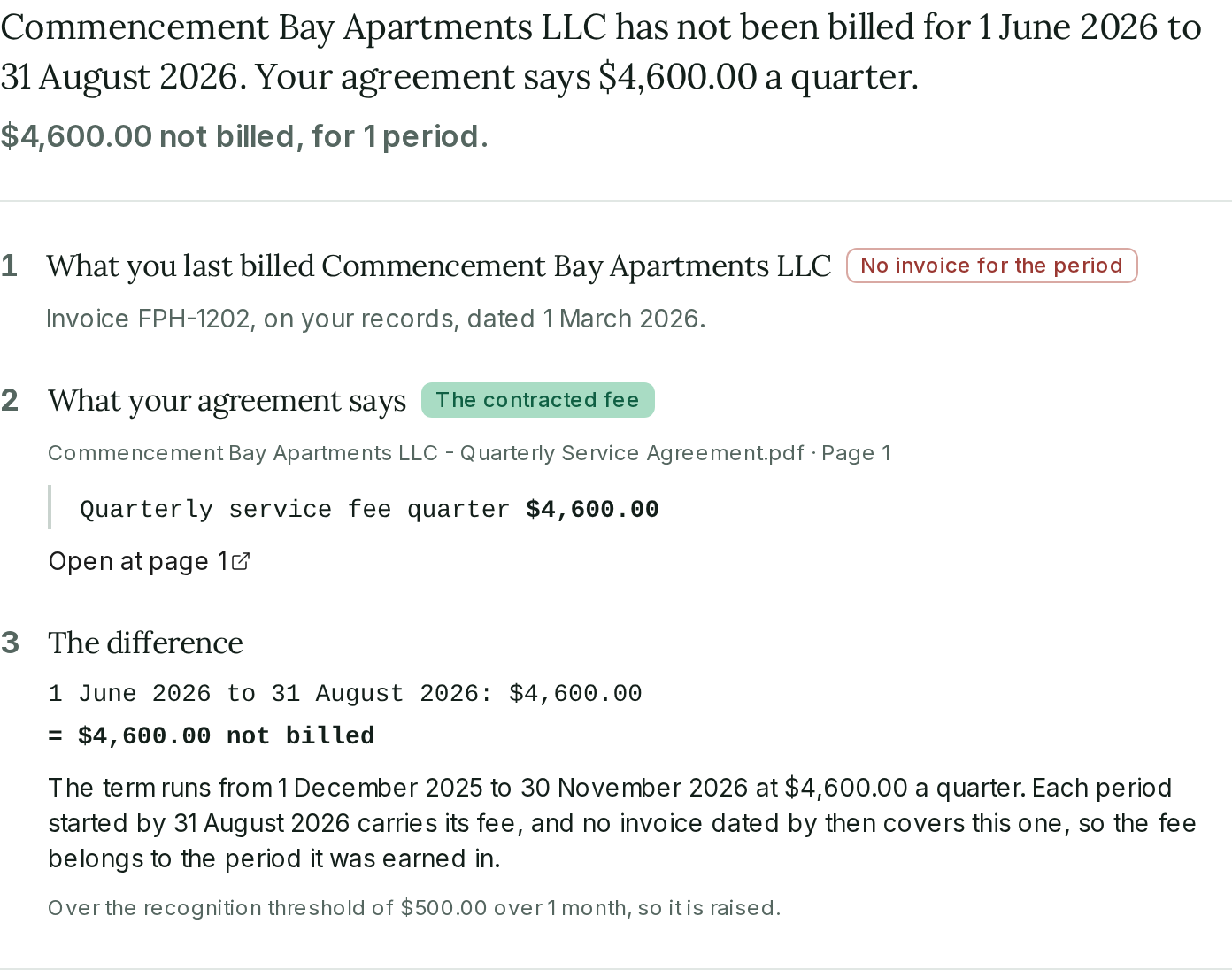
- Missing invoiceA period the agreement lets you charge a fee for, in term or renewed, is raised when no invoice covers it.
What Order-to-Cash needs
- the agreement or price reference the customer accepted (an order form, a rate card, a price list)
- amendments and the price notices you sent, which change a price after signing
- orders and delivery notes
- the invoices you sent
- credit notes, the notes that reduce what a customer owes
- Connections, optional and only after your first Finding: QuickBooks or Xero. Every invoice you send is then checked as you send it. Nothing to connect to start.
Working with Order-to-Cash, in Help, is the how-to: what to put in the Data Room, how to read a Finding and what each step costs.
What Order-to-Cash may ask you
- If an agreement doesn’t say, how many days do customers have to pay you? Unless you say otherwise: 30.
- Is there an amount of under-billing too small to bother you? For example, under 25. Unless you say otherwise: 0.
- What reasons can you give a customer a credit note for? For example: return, breakage, dispute. Unless you say otherwise: return, breakage, dispute, agreed rebate.
- Any discounts you give that aren’t in the customer’s agreement? Name the customer and the discount.
- Does a customer call an item something different from your agreement? Like ‘sixer’ for ‘6-pack case’.
- Do you post deferral journals (entries moving revenue billed early out of the month)? If so, to which accounts, like Deferred revenue 2300? Unless you say otherwise: no.
- How big must a timing difference (revenue in the wrong month) be before you want to hear about it? For example 1,000. Unless you say otherwise: 1000.
Are you invoicing customers correctly?
Audit a supplier for freeOrder-to-Cash is included in Free, Starter, Professional and Enterprise, from $0 a month.
What Order-to-Cash draws on
- Invoiced prices match what the customer agreedCOSO Control Activities, principle 10; SOX: Order-to-cash: pricing accuracy.FASB ASC 606-10-32 (transaction price)
- Accuracy of recorded amountsCOSO Information and Communication, principle 13; SOX: Accuracy of transaction processing.PCAOB AS 1105.11 (audit evidence: relevance and reliability)
- Amendments and price notices are applied from the right dateCOSO Control Activities, principle 10; SOX: Contract change control.COSO 2013; PCAOB AS 1105 (reliability of evidence)
- Authorization of transactions and changesCOSO Control Activities, principle 10; SOX: Authorization of transactions.COSO 2013; PCAOB AS 2201.A5 (definition of internal control over financial reporting)
- Fees the agreement entitles us to are billedCOSO Control Activities, principle 10; SOX: Revenue completeness.FASB ASC 606-10-25 (performance obligations)
- Invoiced quantity matches what was ordered or receivedCOSO Control Activities, principle 10; SOX: Three-way match.COSO 2013
- Deposits and progress invoices reconcile to the final invoiceCOSO Control Activities, principle 10; SOX: Prepayment and deposit accounting.FASB ASC 340-10 (prepaid expenses); ASC 606-10-45 (contract liabilities, receivable side)
- No transaction is recorded or paid twiceCOSO Control Activities, principle 10; SOX: Duplicate payment prevention.COSO 2013; PCAOB AS 1105 (sufficiency of evidence)
- Prices do not move without a documentCOSO Monitoring Activities, principle 16; SOX: Vendor pricing monitoring.COSO 2013
- Dispute deadlines are surfaced while openCOSO Information and Communication, principle 14; SOX: Contract compliance monitoring.COSO 2013 principle 14 (internal communication)
- Credit notes have a basis and an approverCOSO Control Activities, principle 10; SOX: Credit memo authorization.FASB ASC 606-10-32-5 to -9 (variable consideration); PCAOB AS 2401
- Discounts below the agreed price are authorizedCOSO Control Activities, principle 10; SOX: Pricing override controls.FASB ASC 606-10-32 (variable consideration, price concessions)
- Receivables are complete, real and collected on termsCOSO Monitoring Activities, principle 16; SOX: Accounts receivable completeness and aging.FASB ASC 310-10 (receivables); ASC 326-20 (credit losses, context only)
- Revenue is earned over the service period it pays forCOSO Control Activities, principle 10; SOX: Revenue recognition over time.FASB ASC 606-10-25-27 to -30 (performance obligations satisfied over time) and ASC 606-10-32 (measuring progress); IFRS 15 paragraphs 35 to 38 and 39 to 45
- Money billed before the service is delivered is owed to the customerCOSO Information and Communication, principle 13; SOX: Contract liabilities (deferred revenue).FASB ASC 606-10-45-1 to -3 (contract balances: contract liabilities); IFRS 15 paragraphs 105 to 109 (contract balances)
- Revenue is invoiced in the period it was earnedCOSO Information and Communication, principle 13; SOX: Revenue cut-off.FASB ASC 606-10-25-23 to -30 (satisfaction of performance obligations)
- Cut-offCOSO Information and Communication, principle 13; SOX: Period-end financial reporting.FASB ASC 606-10-25 (timing of revenue); PCAOB AS 2401.66
- A contracted period fee is invoiced, and a contracted cost is accrued, in the period it belongs toCOSO Information and Communication, principle 13; SOX: Completeness of revenue and of accrued liabilities at period end.FASB ASC 606-10-45-1 to -4 (contract assets and receivables) and FASB ASC 405-20 (liabilities); IFRS 15 paragraphs 105 to 108 (contract assets) and IAS 37 paragraph 11 (accruals); PCAOB AS 2401.66 (cut-off)
- Completeness of recorded transactionsCOSO Information and Communication, principle 13; SOX: Completeness of transaction capture.PCAOB AS 1105; AS 2810.10-.13