How do you dispute an invoice?
You write to the supplier, in an email or a letter, naming the invoice and the line you dispute, what they billed, what you agreed and the document that proves it, and you ask for a credit note, a document from the supplier that reduces what you owe. Send it as soon as you find the gap and before the dispute window closes, the number of days your agreement gives you to challenge an invoice. Attach the evidence, pay the part of the invoice nobody disputes, and keep the reply with the invoice. If you are the bookkeeper or work in accounts payable, a dispute done this way is quick to settle, and it leaves a record your manager or an auditor can follow without asking you.
When should you dispute an invoice?
You dispute an invoice when a line on it differs from what your company agreed to pay or received, and you can show the difference with a document. The common reasons are a unit price above the agreement, a fee or surcharge the agreement does not allow, a quantity larger than you ordered or received, arithmetic that does not add up, a deposit that was never credited, and an invoice billed twice. A price you think is too high, with nothing that sets a lower one, is a conversation about the next agreement, not a dispute. To find these gaps in the first place, see checking supplier invoices against agreed prices.
Timing matters as much as the reason: many supply agreements set a dispute window, often counted from the invoice date, and a supplier can refuse a claim made after it closes. For goods, the law can set a limit of its own as well: Minnesota’s version of the Uniform Commercial Code, section 336.2-607, for example, says a buyer who has accepted goods must tell the seller of a breach within a reasonable time after discovering it, or lose any remedy. Your own agreement and your state’s law decide the details, so treat the earliest deadline as the real one and raise the dispute the week you find the gap.
What evidence do you need?
You need the documents that let the supplier see the gap without having to trust you. Gather them before you write, because a dispute that arrives with its evidence is usually settled in one reply, while one that arrives without it starts a lengthy exchange of messages.
- The invoice: the supplier’s own document, with its number, date and the line you dispute.
- The agreement: the page or clause that sets the price, the fee or the terms, with any amendment, a signed change that moves a price from a stated date.
- The order or receipt: the purchase order, the delivery note or your receiving record, when the dispute is about quantity. These are the records the procure-to-pay process keeps when you order and receive.
- The arithmetic: the price billed against the price agreed, times the quantity, worked out to the cent.
- Earlier payments: the deposit or earlier invoice the agreement says should be credited, when the dispute is about a credit.
Point to the exact clause or row, not the whole agreement. “Schedule A, row 14, $11.20 a unit” settles faster than “see attached contract”, because the person reading it at the supplier may not be the one who negotiated it.
Should you pay the invoice while it is in dispute?
Pay the lines you agree with on the normal due date, and hold back only the amount in dispute, telling the supplier in the same message which part you are paying and which part you are holding. Paying the undisputed part keeps the account in good standing and shows you are disputing a figure, not avoiding the bill. Holding back money without saying why is short-paying, and it tends to arrive at the supplier as a late payment, with reminders and fees that make the real dispute harder to settle. Check your agreement first, since some agreements say how a disputed amount is handled, and follow it where it does.
If you have already paid the whole invoice, the dispute is identical, except that you request a credit note against the following invoice or a refund, whichever your agreement or the supplier provides.
What goes in an invoice dispute letter to a supplier?
An invoice dispute letter says what is wrong, proves it and asks for one specific fix, in that order, in a few short paragraphs a person at the supplier can act on without a call. Write it to the contact named in the agreement for billing, or to the accounts receivable address on the invoice, and copy the person who negotiated the agreement on your side if they want to know.
- Subject line: the word dispute, your company’s name, the invoice number and the amount, so it is easy to find later.
- The line: the invoice line or item you dispute, with the quantity.
- Billed against agreed: the price or amount billed, the one agreed, and the clause or row that sets it.
- The amount: the difference, with the arithmetic in one line.
- The ask: a credit note for that amount, or a corrected invoice, and the date you would like it by.
- The rest: that you are paying the undisputed balance, and when.
- Attachments: the invoice, the agreement page and any order or receipt.
Keep the tone factual and concise, because many invoice errors are administrative mistakes, a price list nobody updated or a fee added out of habit, and a clear, courteous dispute lets the supplier correct it without anyone losing face.
Walkthrough: one Finding at Ferrygate, from invoice to supplier email
Ferrygate Plumbing & Heating is an invented company, one of the Demo companies Ressura uses to show its checks, and every figure below is made up for the example. It is a plumbing and heating contractor that buys fittings from Cascade Pipe & Supply under a supply agreement with a 30-day dispute window from the invoice date.
The agreement’s price schedule sets $11.20 for a three-quarter-inch brass ball valve. Cascade’s latest invoice bills 30 valves at $12.00 each, $360.00 for the line, with no amendment or price notice on file that moves the price. The Finding the price check raises on that line names the invoice line, the agreement’s row and the gap: $0.80 a valve over, and $0.80 times 30 is $24.00. Every other line on the invoice matches the agreement exactly.
Ferrygate’s bookkeeper has everything the letter needs in that Finding, so the email takes a few minutes. It reads:
Subject: Dispute, Ferrygate Plumbing & Heating, invoice 4471, $24.00
Hello, invoice 4471 bills 30 three-quarter-inch brass ball valves at $12.00 each. Our supply agreement, Schedule A, row 14, sets $11.20 a valve, and we have no amendment or notice that changes it. That is $0.80 a valve over on 30 valves, $24.00 in all. Please send a credit note for $24.00, or a corrected invoice, within 14 days. We are paying the rest of the invoice on its due date. The invoice and the agreement page are attached. Thank you.
The amount is small, and that is precisely why it deserves the email: Ferrygate buys valves from Cascade every month, so a price that is wrong on this invoice is likely to be wrong on the next one too, and $24.00 a month becomes $288.00 over a year before anyone notices.
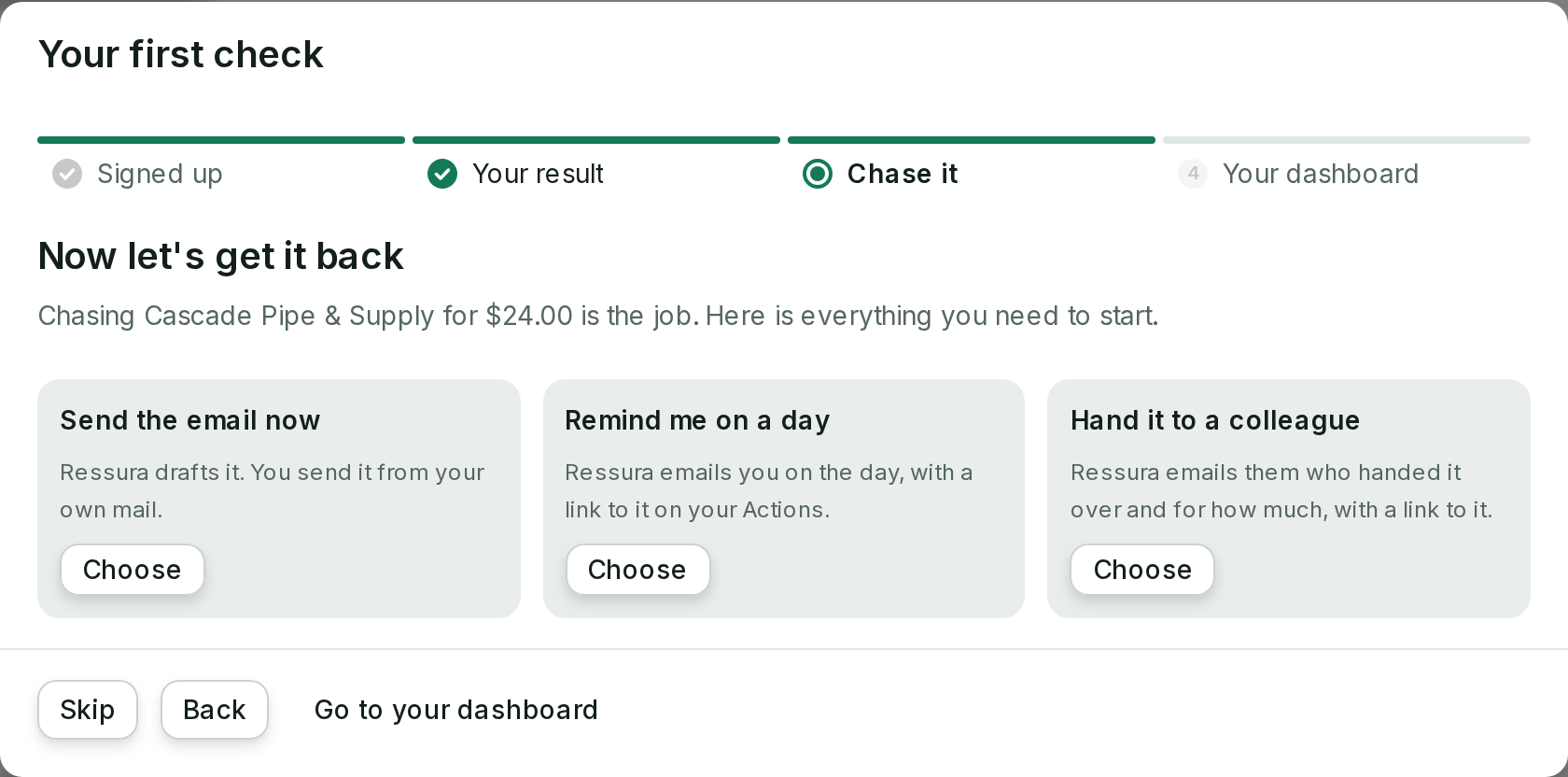
In the Picture above, the same $24.00 reaches the step after the result in Ressura’s free start. Ressura drafts the email from the Finding, and the bookkeeper sends it from their own mail, sets a reminder for a day, or hands it to a colleague.
What happens after you send it?
You wait for a credit note or a corrected invoice, then check that it matches the amount you asked for and that the next invoice from that supplier is billed at the agreed price. A credit note that settles this invoice but leaves the price incorrect on the following one only postpones the problem by a month. When the credit arrives, record it against the supplier, attach it to the disputed invoice and close the dispute, so anyone who opens the invoice later can see what was raised and how it was settled.
Keep the dispute with the invoice for as long as you keep the invoice itself. The IRS says to keep records that support a tax return until its period of limitations ends, generally three years from filing, and the invoice, the credit note and the emails between them are part of that record.
Be careful if the reply asks you to send a refund difference or a future payment to new bank details. Fraudsters write from real or lookalike supplier accounts to redirect payments, and the FBI’s Internet Crime Complaint Center advises using a second channel to verify any request to change account information. Before you change anything, telephone the supplier on the number already recorded in your files, never one provided in the email itself.
What if the supplier refuses?
Ask the supplier to point to the document that supports their price, because a refusal with no document behind it is rarely final. If they name an amendment or price notice you have not seen, ask for a copy, then check whether your agreement lets that notice change the price and from which orders. If it does, the invoice was right and you close the dispute with a note saying why. If it does not, follow the agreement’s own dispute clause, which may name who to escalate to, and take the line, the agreement and the gap to the person you report to, so the decision about the supplier is made with the facts in front of them.
How does Ressura help you dispute an invoice?
Ressura’s Procure-to-Pay Module checks every supplier invoice against your agreement and raises each gap as a Finding, with the invoice line, the agreed figure, the clause it came from and the amount in dollars beside it, which is the evidence a dispute needs. It shows how many days your agreement gives you to dispute an invoice while that window is still open. From a supplier’s page you can draft an email about a Finding and copy it, and Ressura never sends it for you. You can mark the supplier as contacted, and mark the Finding resolved once the money is settled. When every line matches, the result reads All in order and lists exactly what was checked, which is the other good answer to give your manager.